
Collagen Vs. Gelatin: Key Differences and Health Benefits
Collagen is the most abundant protein in the human body. Look in the mirror and you'll "see" this type of protein everywhere:- Hair
- Skin
- Nails
- Bones
- Muscles
- Connective tissue
Collagen production naturally slows with age. As levels decline, skin elasticity decreases, joint discomfort increases, muscles lose mass, and hair loss may become more noticeable.
Gelatin comes from collagen. When you heat collagen, it turns into gelatin. In other words, all gelatin has collagen but not all collagen contains gelatin. Here's how they work in practice. Both are derived from animal connective tissue — cartilage, bones, and hides. Gelatin is commonly sourced from cows or pigs; collagen is typically derived from fish or cows.
In terms of amino acid profile, collagen and gelatin are very similar, but they differ in how they're processed, how quickly your body absorbs them, and how they behave in food and drinks.
One key functional difference: gelatin solidifies in water; collagen does not.
Collagen peptides dissolve cleanly in smoothies, coffee, and cold beverages. Add gelatin to a cold liquid and it clumps; in hot liquids, it gels. That's why gelatin recipes call for dissolving in hot water first, then adding cold to set.
What's Better: Collagen Peptides vs. Gelatin?
For supplementation, most experts recommend hydrolyzed collagen, also called collagen peptides.
In hydrolyzed collagen, the amino acid chains are broken into smaller fragments via a process called hydrolysis, making them faster and easier for the body to absorb.
Research suggests collagen peptides appear in blood plasma within 30–60 minutes, compared to 2–3 hours for standard gelatin.
To put simply, hydrolyzed collagen delivers the same amino acid building blocks as gelatin or food-source collagen, in a form the body can put to use more readily.
The Amino Acid Profile: Where the Benefits Come From
Collagen's benefits are driven by its distinctive amino acid profile, particularly its high concentrations of conditional and nonessential amino acids. Your body uses 20 amino acids. There are nine essential amino acids the body cannot produce on its own, so they must come from the diet: phenylalanine, valine, threonine, tryptophan, methionine, leucine, isoleucine, lysine, and histidine.Most protein powders hold these nine essential amino acids in varying amounts. Any protein that has all nine is called a complete protein. The remaining amino acids: arginine, cysteine, glycine, glutamine, proline, tyrosine, alanine, aspartic acid, asparagine, glutamic acid, and serine — the body can produce on its own, though that doesn't make them unimportant.
Collagen supplies eight of the nine essential amino acids. The only one missing is tryptophan.
In collagen hydrolysate (hydrolyzed collagen), the predominant amino acids are:
- Alanine
- Arginine
- Glutamic acid
- Glycine
- Hydroxyproline
- Proline
Of particular note is hydroxyproline, a modified amino acid derived from proline and rarely found in significant amounts in other dietary proteins. It plays a key structural role in stabilizing collagen in bones, skin, and connective tissue.
While collagen contains all nine essential amino acids, they are not present in equal concentrations. Glycine, proline, and hydroxyproline dominate its profile, which is part of why collagen has such a distinct structural role in skin, joints, and connective tissue.
Collagen pairs well with a complete protein powder if you want to round out the full essential amino acid profile.
Collagen or Gelatin for Hair Health
For hair health, hydrolyzed collagen is the preferred supplement form. Research suggests collagen supplementation may support hair strength and growth rate, help protect scalp skin elasticity, and support hair follicle health. ([1])
Collagen or Gelatin for Joints and Connective Tissue
Collagen and gelatin both support connective tissue and joint health, and joint support is one of the most well-studied applications of collagen supplementation.
As collagen levels naturally decline with age, joint tissue integrity and bone density may be affected. Research suggests consistent collagen supplementation may support joint comfort and connective tissue health. ([2])
Collagen or Gelatin for Skin
Skin health is the best-researched application for hydrolyzed collagen. Studies suggest regular collagen supplementation may improve skin hydration, elasticity, and the appearance of fine lines. ([3])
Collagen is most effective when consumed as a supplement — though collagen powders can also be incorporated into topical skincare routines for a complementary effect.|
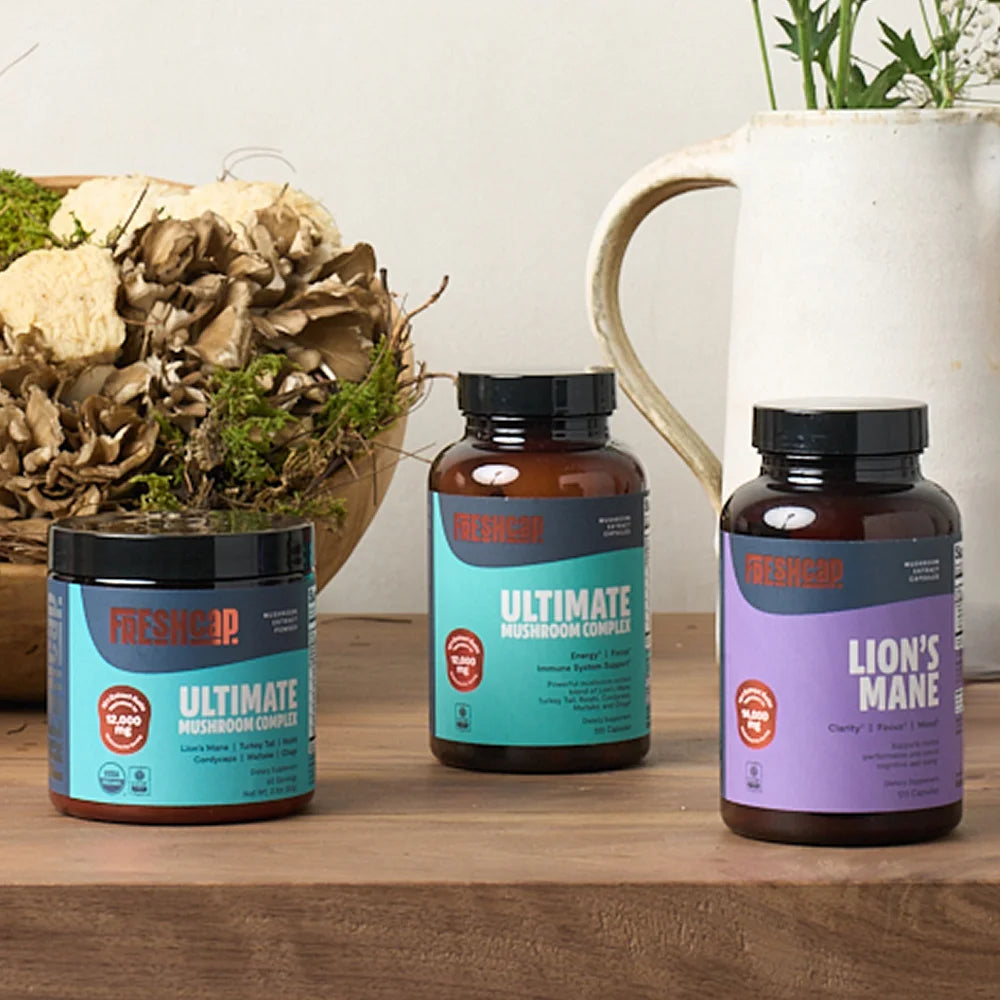
🍄 What About Tremella Mushroom? If you're plant-based, or looking for a complementary approach to collagen for skin, Tremella mushroom (Tremella fuciformis) is worth knowing about. Tremella contains glucuronic acid, a building block of hyaluronic acid, whose molecules are small enough to penetrate the skin's outer layer. Research suggests that Tremella's unique polysaccharides may help skin retain moisture, support the skin's natural barrier, and reduce collagen breakdown over time. In one study, fermented Tremella polysaccharides prompted an increase in collagen and elastin production in skin cells. FreshCap Tremella Mushroom Capsules are made from 100% organic fruiting body, standardized to 40% beta-glucans, and third-party tested. |
Collagen vs. Gelatin for Gut Health
The relationship between collagen and gut health is an active area of research. Some studies suggest both gelatin and collagen may help support intestinal lining integrity, though the evidence in humans is still developing.
Collagen Peptides for Muscles
Muscle mass naturally begins to decline after age 30 — at roughly 5% per decade according to Harvard Health research. Collagen supplementation, combined with resistance exercise, may help support muscle protein synthesis and overall strength.
Research suggests collagen supplementation combined with exercise may support muscle mass and protein synthesis. ([4])
Collagen vs. Gelatin for Cooking
Many people first encounter collagen and gelatin through bone broth and Paleo-style cooking. Both can be used in a wide range of recipes, but their functional properties differ.
Collagen peptides are the better choice for smoothies, coffee, and cold beverages, they dissolve cleanly without gelling. Gelatin excels in gummies, stews, desserts, and marshmallows, where its setting properties are exactly what you want.
If gelatin clumps in your recipe, "bloom" it first: sprinkle the gelatin over cold water, let it sit for a few minutes, then add hot liquid to dissolve it fully before combining with other ingredients.
Both collagen and gelatin are derived from animal sources. Halal and Kosher-certified options are widely available. If you follow a plant-based diet, certain foods support your body's own collagen production — leafy greens, citrus, and berries among them. For a more targeted option, see the Tremella section below.
Collagen vs. Gelatin: Keto Considerations
Both collagen and gelatin are low in carbohydrates, making them generally compatible with ketogenic diets. As with any protein source, total intake should be factored into your daily macros.
Many brands offer keto-formulated collagen products with MCT oil added for additional fat support.
How to Use Collagen vs. Gelatin Supplements
Both are versatile and easy to work into a daily routine. Use the powders in your favorite recipes, stir hydrolyzed collagen into smoothies or coffee, or take collagen peptide capsules for a convenient option.
Side Effects You Should Know
Collagen and gelatin are generally well-tolerated, with no serious known side effects or drug interactions in healthy adults.
Quality matters. As dietary supplements, collagen products are not evaluated by the FDA for efficacy before sale. Because they're derived from animal by-products, manufacturing standards vary widely — making third-party testing, transparent sourcing, and clear labeling important signals when choosing a supplement.
The FDA treats unflavored gelatin sold as a food product under standard food labeling rules. When marketed as a dietary supplement, it falls under supplement regulations instead.
Grass-fed bovine collagen is generally considered a higher-quality source. Grass-fed collagen may also be better tolerated digestively.
What About Tremella Mushroom? A Plant-Based Alternative for Skin Hydration
If you're looking for a plant-based complement to collagen supplementation or simply want to support skin hydration from a different angle — Tremella mushroom (Tremella fuciformis) is one of the most well-researched functional mushrooms for skin health.
Known as the "beauty mushroom" or snow mushroom, Tremella has been used in traditional Chinese medicine for centuries for its skin-supporting properties. Modern research is beginning to explain why.
Tremella contains a compound called glucuronic acid, a building block of hyaluronic acid.
What makes glucuronic acid particularly notable is that its molecules are smaller than hyaluronic acid molecules, which may allow it to penetrate the skin's outer layer more effectively. Research suggests Tremella's polysaccharides may:*
- Help skin retain moisture and support the skin's natural barrier
- Support collagen and elastin production in skin cells
- Protect against oxidative stress that contributes to visible skin aging
- Support skin hydration from within when taken as an oral supplement
Because Tremella is entirely plant-based and vegan-friendly, it's a natural fit for those who want skin support without animal-derived supplements. And because it works through a different mechanism than collagen peptides, many people find it works well as a complementary addition to their existing routine.
FreshCap Tremella Mushroom Capsules are made from 100% organic whole fruiting body — no fillers, no mycelium on grain, and are standardized to 40% beta-glucans for consistent potency. They're USDA Certified Organic and third-party tested for purity.
The Bottom Line
Collagen and gelatin are almost identical in terms of amino acids and health benefits.
Since hydrolyzed collagen is easier for your body to digest than normal collagen peptides and gelatin, it's a better choice for reaping the full range of health benefits.
Plus, you can add collagen peptides to cold liquids like smoothies and other drinks without them gelling. Gelatin, on the other hand, is a little less versatile.